The Unsolved Abd-uction & Mur-der of Denise Sue Clinton
Denise Clinton was excited to visit her grandparents, Chelcie and Dorothy Reynolds, and stay with them at the motel they managed in Kansas City, Missouri. The 9-year-old, who had just returned home to Independence, Missouri, after a family vacation in California with her parents and 6-year-old sister, was looking forward to seeing her grandparents and telling them all about her trip out west. Denise was one of 15 grandchildren, and the kids would often take turns visiting their grandparents so each one could have some one-on-one time with the couple. The trio enjoyed a quiet evening together at the Great Plains Motel on Wednesday, July 7, 1965, and then Denise went to bed on a mattress set up in her grandparents’ living quarters behind the motel office.
Around 2:20 am Thursday, Chelcie and Dorothy were awakened by the sound of the buzzer in the lobby. Dorothy went to the front door and opened it for a man who she assumed was checking into the motel. The man, who was around 30 years old, told Dorothy he needed a single room for the night. He then pulled out a gun, pointed it at her, and announced, “This is a holdup.” With shaking hands, Dorothy took $256 out of the register and gave it to the man.
Once he had the money, the man forced Dorothy back into the room behind the lobby where Denise was sleeping, then pushed her into her bedroom. She quickly told Chelcie they were being robbed and warned him that the man had a gun. The robber used adhesive tape to bind Dorothy and Chelcie’s hands in front of them, then ripped up some white cloth he found in a dresser drawer and gagged them.
The gunman told the terrified couple to lie down on the floor and they immediately complied. He then taped one of Dorothy’s legs to one of Chelcie’s legs, then bound their four legs together so they couldn’t move. He grabbed Chelcie’s wallet and took $2.00 out of it before shoving the gun in Chelcie’s face and issuing a final warning. “Don’t make any funny moves or I’ll kill you.” He then walked out of the room.
Chelcie and Dorothy heard the front door to the hotel close as the man left the building. Still terrified that he would come back and shoot them, they waited about five minutes before they started wiggling out of the tape binding them together. As soon as they were free, Chelcie ran to the lobby and called the police.
As Dorothy made her way through their living quarters, she was stunned to see that Denise was missing. Chelcie quickly called the police back and told them the robbery also included a kidnapping. Detectives from the Kansas City Police Department responded immediately. Within 20 minutes, they had set up a roadblock on the highway near the hotel. They stopped every car that passed through the area but didn’t find any sign of Denise.
The man had spent around 10 minutes in the motel, giving Dorothy and Chelcie plenty of time to get a good look at him. Dorothy described him as a handsome man with bright blue eyes. A guest at the motel told investigators he looked out his window as he was preparing for bed around 2:15 am and saw a light-colored 1960 Oldsmobile in the parking lot. When he turned his light out shortly after 2:30 am, the car was gone. None of the other occupants of the hotel could identify this car, leading detectives to believe it might have belonged to Denise’s abductor.
Investigators were able to recover a palm print and part of a fingerprint from the adhesive tape that had been used to bind Chelcie and Dorothy. There was no national database available at the time, so the prints would only be of use if a suspect or person of interest could be identified.
Within hours of Denise’s abduction, 10 FBI agents and more than 90 Kansas City police officers were scouring the city for any sign of her. At first, they hoped that Denise might have woken up during the robbery and gotten frightened enough that she ran off somewhere to hide. As time went by without any sightings of her, however, they realized this wasn’t the case. They believed the robber had made a spur-of-the-moment decision to abduct the little girl, but they were unsure what he planned to do with her. Kansas City Police Chief C.M. Kelly said he didn’t believe ransom was a motive because the family was of modest means.
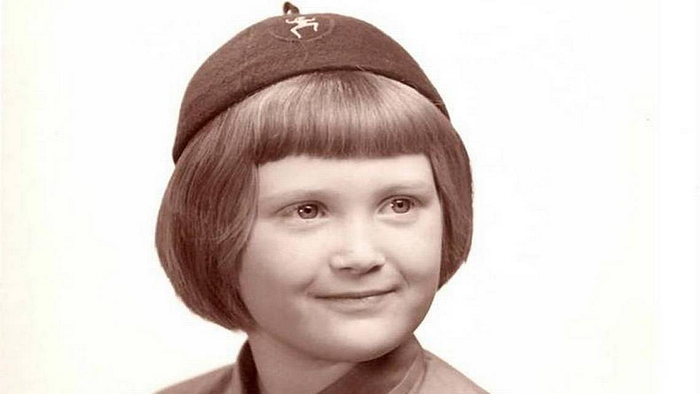
Denise’s father, Russell Clinton, said that no one had contacted the family to demand a ransom. “I wish I had heard from someone. I’d feel a lot better.” His wife, Betty, fought back tears as she described her daughter to reporters. “She has short, straight hair…it’s reddish-blonde. She has blue eyes and freckles across her nose and a tiny cleft in her chin.” She pointed out that the little girl was only wearing a short, blue and white nightie. “She is barefooted and we would do anything to return her to safety.”
Denise was described as a somewhat shy but friendly child who was a member of a local Brownie troop and had been looking forward to becoming a Girl Scout the following year. The previous fall, she begged her parents to let her start taking accordion lessons and fell in love with the instrument. She was a talented artist who had recently completed third grade at the Three Trails School in Independence.
Police were determined to find Denise, but as hours went by they began to worry that she had been taken outside of Kansas City. By early afternoon, they had searched most of the roads in the city a total of four times, using foot patrols, motorcycles, search dogs, helicopters, and a plane. They found no clues to Denise’s whereabouts.
The Great Plains Motel was located on Interstate 29 in the northern section of Kansas City, where the area was still quite rural. The motel, along with a small restaurant and bar, were the only businesses in the immediate area. Volunteers helped police officers comb through fields and wooded areas, searching in vain for any clues that might lead to Denise or her abductor. The search expanded on Friday, with dozens of Civil Air Patrol cadets and students joining the hunt for the missing child.
Volunteers combed along U.S. Route 71 between Platte City and Platte Woods, while police asked property owners living within a 10-mile radius to search their fields and outbuildings for anything unusual. Denise’s grandfather joined the search party, saying he was too keyed up to remain at the motel and wanted to do something to help find his granddaughter. At 63 years old, he was the oldest member of the search party.
Keith Reynolds, one of Denise’s uncles, also joined in the search for his niece. He told reporters he had mixed emotions about the search effort. “In a way, I hope we don’t find anything. I mean…I hope we don’t find Denise lying in some ditch.” He wanted to believe that she would be found alive and reunited with her family.
Police used a boat to search Prairie Lee Lake in Jackson County after someone called the Jackson County Sheriff’s Department and claimed that Denise would be found in the Prairie Lee Lake area. They spent hours scouring along the bottoms of the bluffs that surrounded the lake but didn’t find any sign of the missing girl.
Denise’s family tried to remain optimistic, but Dorothy admitted that she feared she was never going to see her granddaughter again. She spent a sleepless night trying to understand why the man who robbed the motel would have taken the little girl; she told Betty that she wished the man had taken her instead.
Detectives said they were looking for 32-year-old Robert Lee Hays for questioning in Denise’s case as well as several other robberies in the Kansas City area. The FBI stated that Hays was also wanted for unlawful flight in connection with a robbery in Topeka, Kansas. Investigators admitted that they had no evidence linking him to Denise’s abduction but noted that he matched the description of the man who robbed the motel. Dorothy was shown a picture of Hays taken in 1961 and said he looked similar to the robber.
Investigators were kept busy following up on calls from people who believed they had seen the missing girl. One man was certain he had seen Denise at a service station in Independence Thursday evening. She was with a man who was driving a white 1960 or 1961 Oldsmobile. The witness said the man was acting suspiciously and the child, who matched Denise’s description and was wearing a loose-fitting blue and white dress, had two cuts on her face. The man said she had been scratched by a cat.
According to the witness, the little girl looked scared and was very pale. The man she was with was around 5 feet 10 inches tall and weighed approximately 190 pounds. He was wearing a white shirt, black pants, a dark brown sports coat, and a straw hat. They left the service station and headed west on U.S. Route 40. FBI Special Agent Karl Dissly told reporters this tip was the only good lead they had received.
On Saturday, eight military helicopters joined the search for Denise. Crews conducted aerial searches of Platte County while more than 100 police officers and volunteers continued to search the area surrounding the motel on foot. By Sunday, the search had expanded north, covering the distance between Kansas City and the Iowa border.
On Monday, July 12, 1965, local police and FBI agents held a conference to determine what to do next in the search for Denise. Despite the extensive physical search, they hadn’t found any trace of the missing girl. They decided to halt the large-scale search and concentrate on developing investigative leads. They remained hopeful that they would find Denise alive but admitted that their fears for her safety grew with each passing day.
Denise’s paternal grandparents, Ernest and Christine Clinton, announced that they were offering a $1,000 reward for information leading to the little girl’s safe return. They hoped that the offer of a financial reward would bring in some new leads for investigators, who feared the case was starting to stall.
The Kansas City Police Department had 4-page bulletins printed about the case and mailed them to police departments across the country. The bulletin included photographs of Denise as well as a description of her abductor and pictures of a 1960 Oldsmobile similar to the one the kidnapper was thought to be driving.
Kansas City Maj. James Newman said that the department’s primary goal was to find Denise alive, but after 10 days and more than 10,000 man-hours, they had no idea where to look next. “The primary motive appears to have been robbery. The taking of Denise must have been on impulse.” Detectives didn’t believe she had been taken hostage, as she hadn’t been released yet and there had been no ransom demand. They feared the abduction may have been sexually motivated.
As the search for Denise entered its third week, detectives admitted that the investigation had hit a brick wall. They had checked out each tip they received, traced the ownership of more than 3,400 Oldsmobile sedans in Missouri and Kansas, and sent thousands of flyers about the case across the country. Nothing had led to Denise’s whereabouts or the identity of her kidnapper.
For Russell and Betty Clinton, the wait was agonizing. In the first three weeks following her daughter’s disappearance, Betty lost 14 pounds, unable to eat or sleep while she waited for word about Denise. She refused to leave the house, afraid she would miss a phone call with news that her daughter had been found. Diana refused to sleep in the bedroom she shared with her older sister, fearful that something might happen to her.
Kansas City Mayor Ilus Davis asked for citizens to contribute to a reward fund, hoping that an increased reward would help lead to Denise. He hoped to raise $10,000; in the first week, more than $5,500 in donations was received. Children held puppet shows and sold cold drinks to raise money, travelers passing through the area chipped in, and local businesses sent checks. A Cub Scout pack even organized a day-long carnival and donated all the money from it to the reward fund. Everyone wanted to do whatever they could to help bring Denise home.
By August 17, 1965, the reward fund topped $10,000. The increased publicity about the case also brought in a few anonymous tips to the FBI, and agents were busy following up on each one. Although many of the investigators didn’t believe they were likely to find Denise alive, they were determined to identify the person who abducted her.
On August 30, 1985, Ernest Clinton, Denise’s paternal grandfather, died suddenly at the age of 62. The farmer, who had offered a $1,000 reward for the return of his granddaughter, died without learning what had happened to the little girl. Some thought the stress of her disappearance contributed to his death. It was yet another tragedy for a family that was already dealing with so much.
Three months after Denise was last seen, detectives had followed up on more than 2,000 leads without success. With no new tips coming in, the investigation was at a standstill. Investigators admitted that the case became more baffling as time went on and there were no reported sightings of the missing child. Denise — and her abductor- had seemingly disappeared into thin air.
The $10,000 reward for information in Denise’s case was initially scheduled to expire in November 1965. C.T. Thatcher, the managing director of the Kansas City Crime Commission, announced that the deadline was being extended until January 21, 1966. As the new deadline approached, the decision was made to extend it until May 23, 1966, then again until August 18, 1966. After that, the money was returned to its donors.

In July 1966, police were finally able to find and arrest Robert Hays, who had been on the run with his wife for nearly a year. He was found in Oklahoma City, Oklahoma, and arrested on an outstanding robbery warrant from Kansas. He was questioned about Denise’s abduction but denied having anything to do with it. Chelcie and Dorothy were brought to the police station to view Hays and confirmed that he was not the man who robbed them and took Denise. Detectives said this completely eliminated him as a suspect, leaving them with no persons of interest in the case.
On the first anniversary of the kidnapping, Kansas City Police Col. Don Bishop admitted that the case was a frustrating one. “It’s as though she has been swallowed up by the earth. Every bit of information has been carefully evaluated and every lead thoroughly checked. But we have found nothing of the little girl.”
Denise’s case soon faded from the headlines. Although detectives said the case was still active, they admitted they had exhausted all leads. Everything changed in September 1967, when two cowboys found human remains near Devil’s Tower Monument in Wyoming. Dental records confirmed that the body belonged to Denise. The kidnapping investigation was now a homicide case.
The skeletal remains were found on the Morse Hauber ranch. Bits of fabric and a child’s wristwatch, as well as pieces of rope, were found near the remains, which were lying near Forest Service road that saw little traffic. They had been found on July 27, 1967, but hadn’t immediately been linked to Denise’s case. When they couldn’t be matched to any missing person from Wyoming, they were sent to the FBI lab in Washington, D.C., where it determined they belonged to the missing girl from Kansas City.
Investigators combed through the area where the remains had been found but didn’t find any evidence pointing to the identity of the killer. Although Denise’s body hadn’t been dumped along a main highway, it was in a spot that was easily accessible by anyone passing through the area, including tourists who came to see Devil’s Tower.
FBI agents circulated a sketch of Denise’s abductor to gas stations and restaurants located along all the major highways between Kansas City and Wyoming, hoping to find someone who might have recalled seeing him and Denise as they made their way to the site where her body was found. They were hindered by the fact that the abduction had taken place more than two years earlier, and they had no idea if Denise was still alive when the kidnapper left Kansas City with her.
Over the years, detectives heard from jailhouse informants and other people who thought they knew who was responsible for Denise’s abduction and murder, but they were never able to connect anyone to the crime. Both of her parents are now dead; Russell died in 1985 and Betty in 2006. Denise’s younger sister, Diana, still remembers the pain she felt when she learned that Denise was never coming home. “I miss her…I think about all the things we didn’t get to have.”
In 2017, Diana admitted that she doubted she would ever learn who was responsible for her sister’s death. “At this point…he’s probably dead. I think everybody would like to have closure, but I don’t think we will ever know.”

Denise Sue Clinton was just 9 years old when she was abducted from Kansas City, Missouri, and murdered in July 1965. She was a polite and somewhat shy little girl who loved the Beatles and enjoyed spending time with her friends and family. While her case remains open, it has been years since police have had any new leads and her sister doesn’t believe the case will ever be solved. If you have any information about Denise’s murder, please contact the TIPS Hotline at 816–474–8477.