
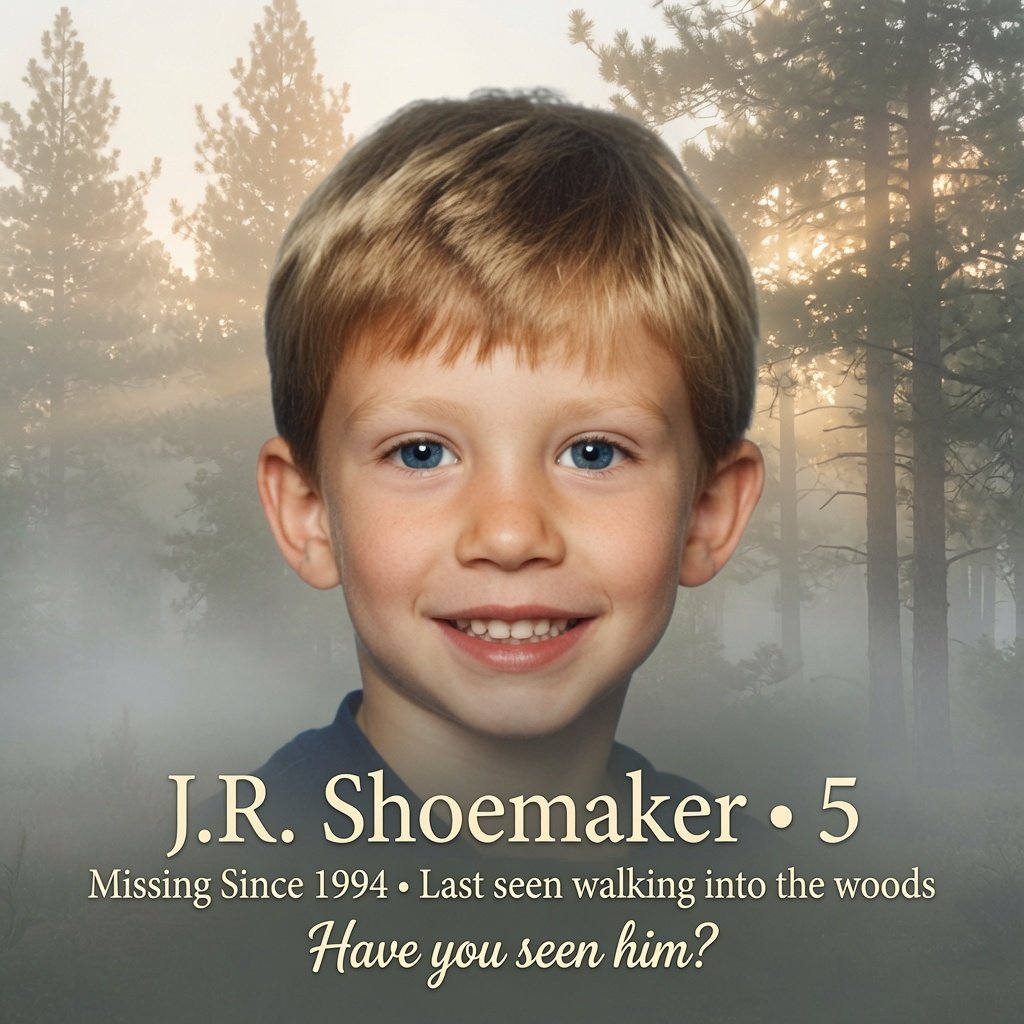
The Unsolved Disappearance of J.R. Shoemaker
The bedroom of Victor Dwight Shoemaker Jr. has stayed exactly the same for more than 30 years. The Ninja Turtles bedspread. The Nintendo console. The bicycle with training wheels still parked in the corner. Roughly a dozen wrapped Christmas presents, never opened, still sitting where they were left. His parents have kept it all in place since the Sunday morning in 1994 when their five-year-old son walked into the West Virginia woods and never walked back out.
A Long-Awaited Only Child
Victor Dwight Shoemaker Jr. — known to everyone as J.R. — was the only child of Victor Shoemaker Sr. and Nettie Shoemaker, a couple who had tried for years to have a baby before J.R. finally arrived. Because of how long they’d waited for him, the Shoemakers were unusually protective parents. They lived in Leesburg, Virginia, where Victor Sr. worked as a maintenance man at an apartment complex and Nettie worked an assembly line job at an electronics plant. J.R. spent most of his days in the confines of their apartment, building houses out of cardboard boxes and drawing pictures of animals and snowmen.
What he loved most, though, was visiting his step-grandfather, Oscar Wolford, whose mobile home sat in the remote hamlet of Kirby, West Virginia, on the edge of Short Mountain — a rugged, roughly 8,000-acre stretch of wilderness that was popular with local hunters. Every time the family made the drive out from Leesburg, J.R. recognized the turn into the mountain subdivision before anyone told him they’d arrived. He loved crossing the creeks and climbing the trees, and even in cold weather he hated wearing shoes and socks if he could help it.
The Last Morning Anyone Saw Him
On Saturday, April 30, 1994, the Shoemakers drove out to Kirby for a family visit. The next morning — Sunday, May 1 — J.R. headed into the woods behind his grandfather’s mobile home with his two older cousins, 9-year-old Tommy Martin and 8-year-old Lloyd Wolford. The boys had brought a BB gun along and were playing at being hunters, something they’d done together countless times before. It was, in fact, the only wooded area J.R.’s parents ever let him play in without being directly in their sight — familiar ground, in a spot they trusted.
According to the two older boys, J.R. began struggling to keep up with them as the morning went on. Around 8:30 a.m., the group reached an old abandoned trailer deep in the woods. There, J.R. announced he was hungry and wanted to go back to his grandfather’s house to eat. His cousins wanted to keep exploring and didn’t want to turn back yet. So J.R. set off alone, back in the direction he’d come from, planning to walk the familiar route home by himself.
He was wearing a red Bugs Bunny T-shirt, red shorts, and white X-Men sneakers.
He never arrived.
Hundreds Search a Mountain in the Rain
When J.R. didn’t show up and his cousins came back without him, the alarm went out quickly. By that afternoon, neighbors, police, and volunteer firefighters were already combing the woods, and a command post was set up near the family’s trailers. What followed became one of the largest search efforts the region had seen. Over the following five days, in steady rain and nighttime temperatures dipping into the 30s, more than 400 volunteers poured in from West Virginia, Virginia, Maryland, Pennsylvania, Washington, D.C., and North Carolina to help look for him. A local church became a 24-hour command post, and a nearby McDonald’s donated food to searchers around the clock for a week straight. Search teams used dog units and a helicopter equipped with infrared technology to scan the rugged terrain for any sign of heat or movement.
The search came at a terrible cost. On the third day, a woman named Lisa K. Hannon, who had been helping coordinate an all-night search effort, was killed when her car ran off the road and struck a tree.
By Thursday, May 5, with no trace of J.R. found anywhere on the mountain, the large-scale ground search was called off. Over the following five months, National Guard and Army Reserve units continued using weekend training exercises to comb the area for any further sign of him. Nothing was ever found — not a shoe, not a scrap of clothing, nothing.
A Case That Never Added Up
From the beginning, investigators were split on what had happened. On paper, a lost child dying of exposure in unfamiliar, dangerous terrain might have made sense in many cases — but authorities and J.R.’s parents alike pointed out that this explanation didn’t quite fit. J.R. knew that stretch of mountain well; he’d walked it with his cousins many times and always found his way back before. His father, Victor Sr., has said he doesn’t believe his son simply got lost and died alone in the woods.
What troubled investigators and the family even more was the behavior of the two older cousins after they emerged from the woods without J.R. Victor Sr. has said the boys seemed to act strangely when they came out and reported J.R. missing, and that when he later tried to talk to them about what happened, they wouldn’t say much of anything. At one point during the initial search, one of the cousins was asked what he thought had happened to J.R. and gave an unsettling answer: that someone had been hiding behind a tree and grabbed him. Despite the suspicion this raised, both boys were interviewed multiple times by investigators and passed polygraph examinations. No evidence was ever found connecting them to J.R.’s disappearance, and police have stated they’ve found no indication of foul play by any family member. Still, the relationship between the two families fractured; the Shoemakers and the cousins’ relatives have not spoken since 1994.
Investigators also looked into other leads over the years. A dark blue 1990-model pickup truck was reportedly seen in the area around the time J.R. disappeared, and in 1997 the FBI received a tip about the vehicle — though it never led anywhere concrete. The FBI’s involvement itself was notable: agents joined the investigation under federal kidnapping law jurisdiction, meaning authorities considered the possibility J.R. may have been taken across state lines. To date, no suspects have ever been identified, and no arrests have been made.
Three Decades of Waiting
For years afterward, the Shoemakers returned to Short Mountain almost every weekend, searching on their own even after official efforts wound down. They kept J.R.’s bedroom exactly as it was, hoping he might someday walk back into it. On the 20th anniversary of his disappearance in 2014, his parents spoke publicly again, sharing an age-progressed image of what J.R. might look like at 24 years old, and reiterating that they still believed their son could be alive somewhere — even suggesting the painful possibility that he may have been raised under a different identity, unaware of his own past.
“We’re hanging in there,” Victor Sr. told reporters at the time, adding that he simply wanted someone with information to come forward and help bring his son home.
The case has continued to draw comparisons to other high-profile stranger-abduction cases in which victims were eventually found alive years or even decades later, which is part of why the Shoemakers have never been willing to give up hope. Officials with the National Center for Missing & Exploited Children have echoed that sentiment, noting that while they don’t want to create false hope, there is always a chance in missing children’s cases — and that the family deserves answers after so many years of waiting.
Still Unsolved
More than three decades after that Sunday morning on Short Mountain, J.R. Shoemaker’s case remains open and unsolved. No trace of him — no remains, no belongings, no confirmed sighting — has ever surfaced. If he is alive today, J.R. would be in his early thirties.
For his parents, the not-knowing has been its own particular kind of grief: no answers, no closure, and a childhood bedroom that has waited, untouched, for over 30 years.
Anyone with information about the disappearance of Victor Dwight Shoemaker Jr. is asked to contact the West Virginia State Police at (304) 822-3561 or the FBI.